

Foundation Crack vs Parging Problem: What's the Difference?
Cracked parging does not always mean the foundation itself is cracking. Sometimes the issue is mostly surface failure. Sometimes it points to moisture, movement, or a broader condition that needs closer review.
The real question is whether the crack is mainly in the finish layer or whether the surface is reacting to something deeper behind it.
Why This Question Matters
Parging is a surface layer, so it can crack even when the deeper wall condition is less dramatic than it first looks. At the same time, repeated cracking, moisture exposure, or movement-related signs can mean the surface is reacting to a broader masonry problem.
This is why surface appearance alone should not be treated as a full diagnosis.
When It May Be Mostly Surface Parging
If the finish coat is thin, weathered, poorly bonded, or already letting go in sheets, the problem may be mostly in the parging layer itself. In those cases, the visible cracks can be more about bond failure and surface condition than about deeper wall movement.
If that sounds familiar, read more about why parging fails before repair.
When It May Point to Movement or Moisture
If the cracking is repeating, the wall is damp, the surface is shifting, or the surrounding area shows broader distress, the issue may be more than a finish-coat problem. Movement, moisture pressure, freeze-thaw exposure, or unstable backing can all make simple re-parging a poor answer.
Important boundary: This page is masonry-contractor planning guidance. It is not a structural engineering diagnosis, and if engineering review is required that sits outside normal masonry-contractor scope unless specifically arranged.
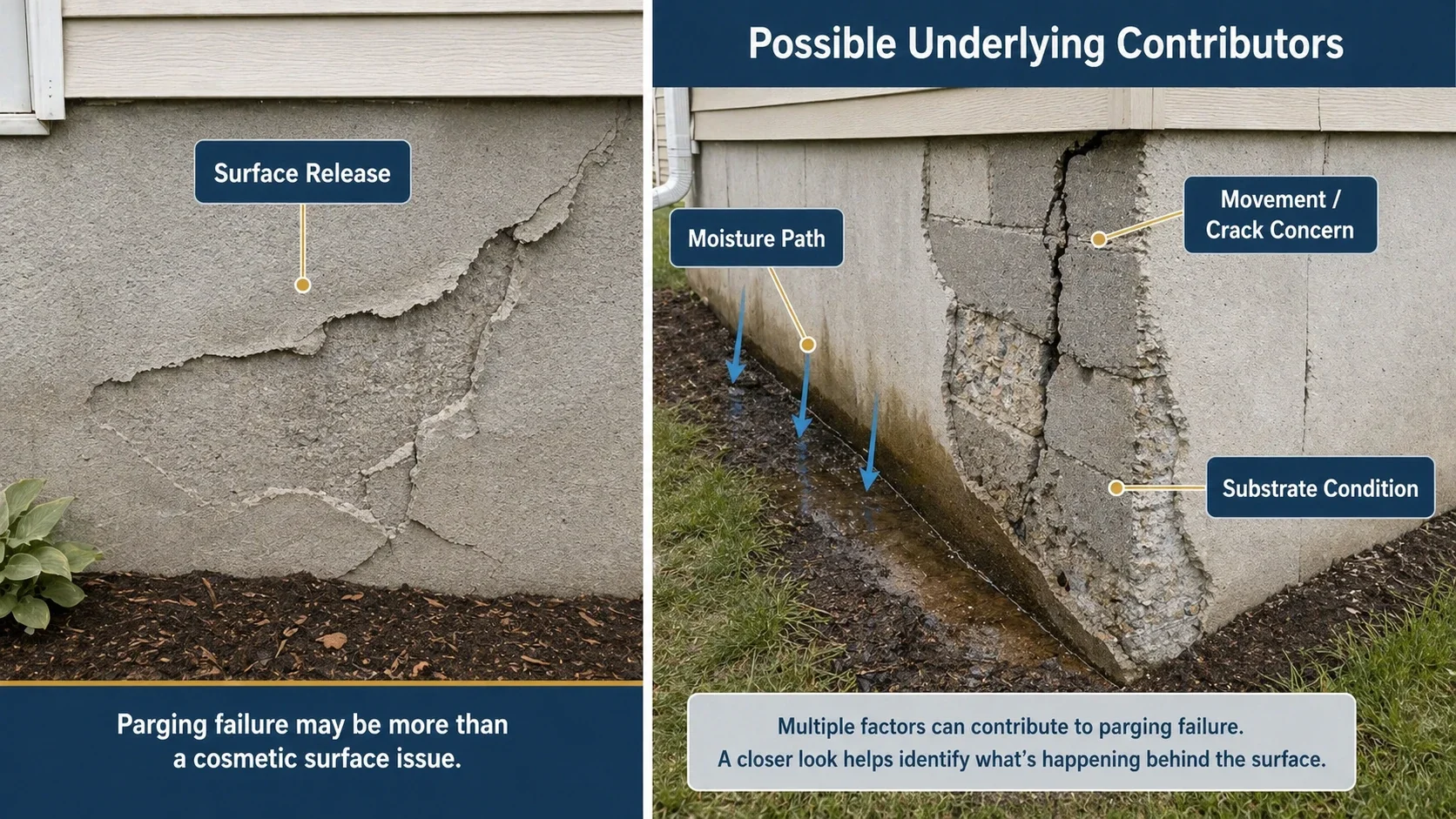
Why Re-Parging Alone May Not Solve It
Re-parging alone may not solve the problem if the underlying cause is still active. If moisture, movement, unstable backing, or broader surface failure is still there, a fresh finish coat can crack or release again for the same reason the first one failed.
If the temptation is to do the smallest visible correction and move on, it may also help to read when a patch is reasonable and when it becomes poor value.
When a Closer Assessment Makes Sense
A closer assessment makes more sense when the important facts are still unclear. That is especially true when the cracking pattern, moisture source, or wall condition cannot be judged responsibly from photos alone.
An onsite assessment is a paid contractor evaluation for repair planning and quotation, not an engineering report. If approved repair work moves forward, the pre-tax assessment fee is credited toward that work.
If that distinction is the main question, read more about assessment versus quote.
What This Means For Your Project
If the failure is mainly in the finish layer, the repair may stay on a more limited parging path.
If moisture, movement, or broader wall trouble seems to be part of the picture, the responsible path may be more than surface repair alone.
The best first step is usually to send clear photos through intake so the surface condition and surrounding context can be reviewed together.
Related Questions
What To Do Next
You do not need to decide on your own whether the cracking is just in the finish or part of something deeper. A few clear photos and a short description are usually enough to point the job toward the right next step.